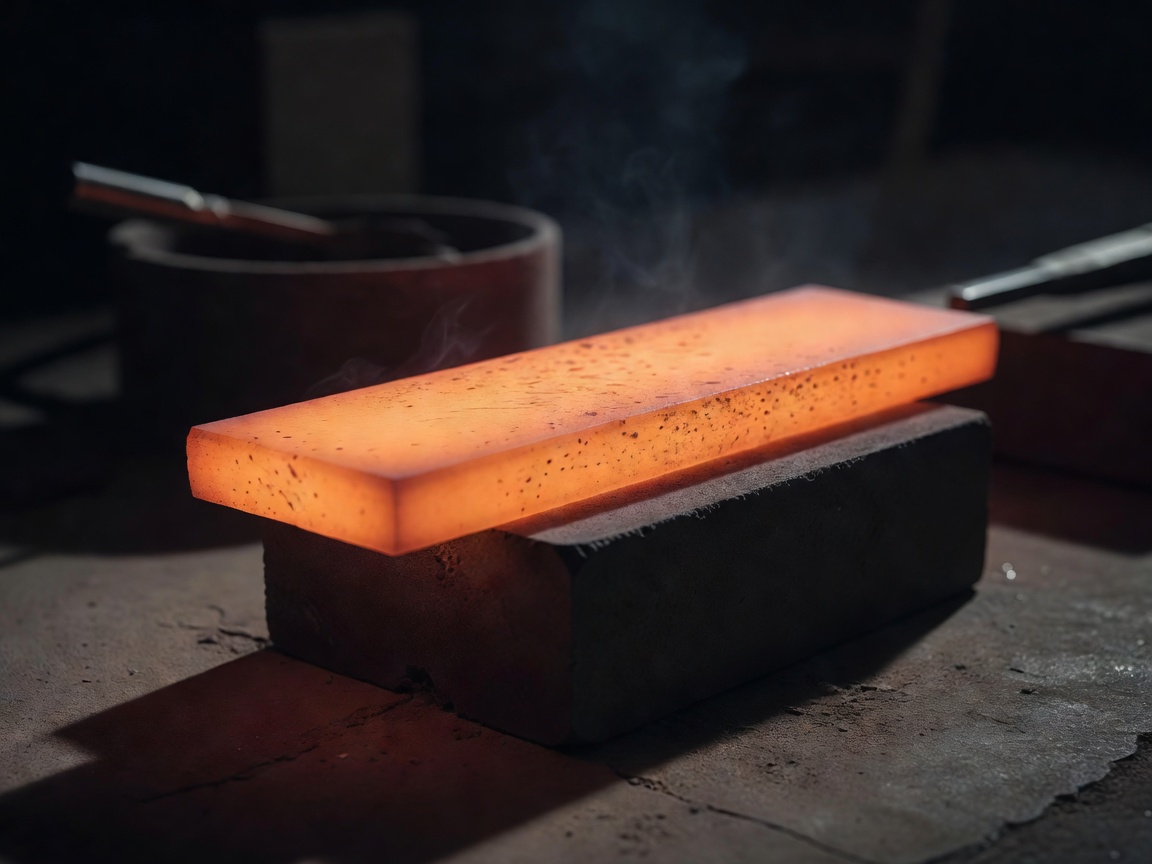
Heat treatment changes steel’s internal structure to balance hardness, toughness and dimensional stability. A successful sequence requires known material, even heating and an appropriate cooling rate. Color is useful, but lighting and surface condition make it an unreliable specification by itself.
Identify material before treatment
Mild steel contains too little carbon for conventional through-hardening and is suitable for fixtures, hooks and many decorative forms. Medium- and high-carbon steels may harden, but each grade has a recommended temperature range and quench severity. Alloying elements change hardenability, tempering response and safe cooling rate.
The safest approach is to purchase identified steel and use its supplier data. Spark appearance and file response can offer broad comparisons, but they do not establish an exact grade. Unknown scrap may produce acceptable experiments, yet it is inappropriate for safety-critical tools where failure could injure someone.
Normalizing after forging
Forging creates uneven grain conditions and residual stress, especially when the work experiences different temperatures across its section. Normalizing heats suitable steel into its austenitizing range and allows it to cool in still air. The process can refine structure, reduce stress and prepare the part for machining or hardening.
Several descending-temperature thermal cycles are sometimes used for grain refinement, but arbitrary cycling is not a replacement for grade-specific practice. Heat slowly enough for the core to follow the surface. Thin edges overheat before thick areas, so move the work within the forge and avoid directing the hottest flame at a finished edge.
Hardening and the quench
During hardening, suitable steel is heated to its specified austenitizing range, held only as required for an even transformation and cooled fast enough to form a hard structure. Magnetism can indicate a transition region in many carbon steels, but the loss of magnetic attraction is not itself a complete hardening temperature guide.
Quench medium matters. Some steels are designed for water, others for oil or air. A faster quench increases thermal shock, distortion and cracking risk. Never substitute a harsher medium simply to make a part harder. Use enough quenchant to avoid excessive temperature rise, keep the vessel stable and maintain a clear path from forge to tank.
Tempering restores toughness
Freshly hardened steel may be too brittle for service. Tempering reheats it below the critical range to reduce brittleness while retaining useful hardness. Temperature and time are selected around steel grade, cross-section and required performance. Cutting edges, punches, springs and striking tools do not share one universal temper.
Oxide colors on polished carbon steel can help indicate surface temperature during traditional tempering, but they are influenced by alloy and atmosphere and do not show core temperature. A controlled oven and reliable thermometer generally provide more repeatable treatment for parts that fit. Clean oil residue before placing a part in domestic equipment, and avoid food-use appliances where contamination is possible.
Geometry controls risk
Sharp internal corners, abrupt thickness changes and deep scratches concentrate stress during quenching. Finish transitions smoothly before hardening and leave thin cutting edges slightly thicker for treatment. Final grinding can then establish geometry without decarburized surface material at the edge.
Agitation should be deliberate and suited to the part. Moving a blade edge-to-spine may encourage warping differently from moving it lengthwise. Do not wave a long part sideways through quenchant. Keep movement controlled, and never reach into a quench tank until the work is known to be cool.
Testing and documentation
A file test can provide a quick indication of whether a surface hardened, but it does not measure toughness or reveal the core condition. Test coupons made from the same material and section can be broken or examined without sacrificing the finished object. Professional hardness testing is appropriate where quantified performance matters.
Record the steel designation, dimensions, heating method, quench medium and tempering schedule. If distortion or cracking occurs, change one variable at a time. Heat treatment becomes repeatable through documented process rather than memory of color.
A disciplined sequence
Complete forging at appropriate temperatures, refine transitions, normalize as the steel requires, prepare the surface, harden with the specified medium and temper promptly. Inspect for cracks before sharpening or putting the tool into service. When the steel is unknown or the consequences of failure are high, seek qualified metallurgical or heat-treatment advice.