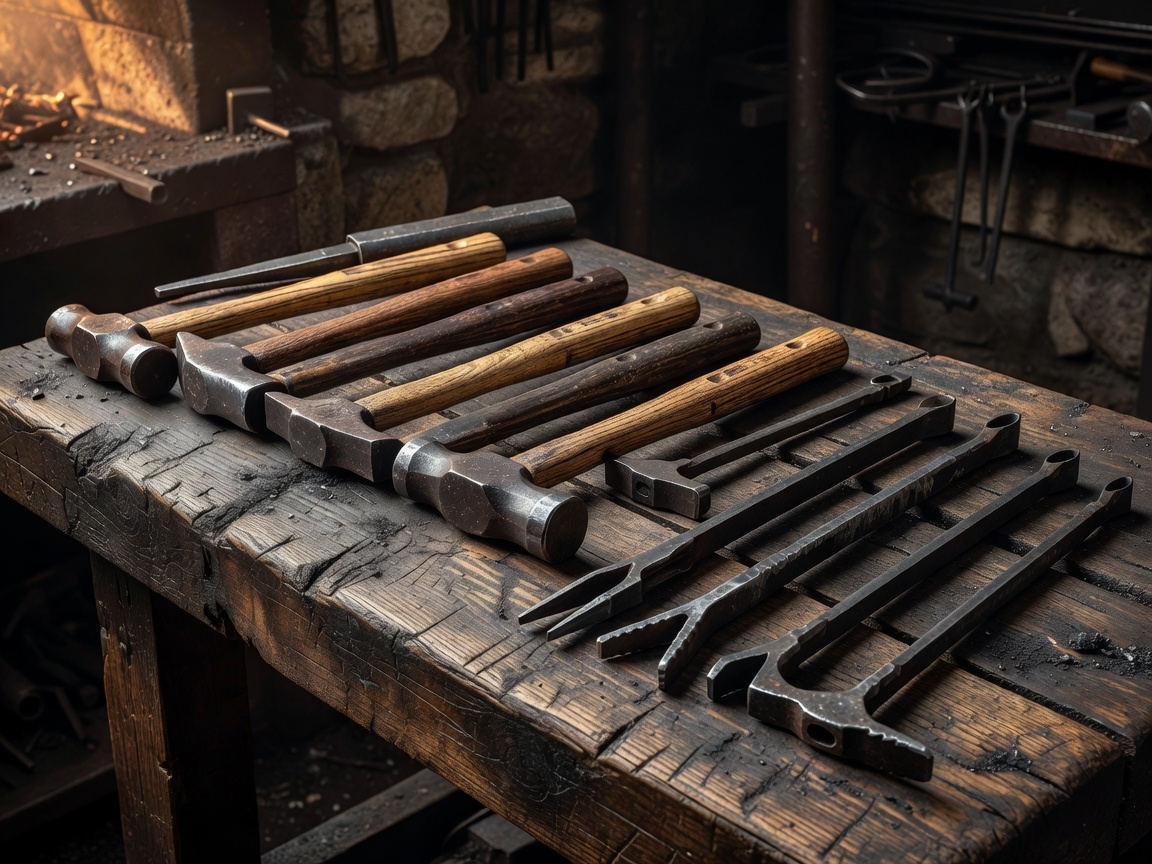
Forging tools connect the body to hot steel. Poor hammer balance wastes effort, while poorly fitted tongs force an exhausting grip and allow stock to twist. Both tools should support relaxed, repeatable movement.
Begin with one general-purpose hammer
A cross-peen or rounding hammer can perform most introductory work. The flat face smooths and controls dimensions; the peen or rounded face moves material more aggressively in a chosen direction. Face shape influences the mark left in the steel, so transition gradually from moving material to refining the surface.
Choose a weight that can be accelerated and stopped accurately throughout a session. A heavy hammer does not compensate for cold steel, poor aim or an unstable stance. If the wrist collapses, the shoulder rises or blows begin to glance as fatigue develops, use a lighter hammer and improve heat management.
Face preparation
Sharp factory edges can leave deep half-moon marks. A forging hammer normally benefits from a smooth face with blended edges and no chips or mushroomed metal. The exact crown depends on purpose: a flatter face supports planishing, while a more pronounced crown moves material quickly but leaves deeper impressions.
Dress damage with appropriate abrasive equipment while keeping the tool cool enough to avoid altering heat treatment. Remove only what is necessary. Polishing to a flawless mirror is optional; a smooth, scratch-free working surface matters more than appearance.
Handle fit and grip
Wooden handles absorb some shock and can be shaped to the user. Grain should run along the handle rather than across it, and the eye must fit securely. Inspect for cracks, looseness and damaged wedges before use. A loose head is an immediate stop condition.
A bulb or slight swell at the end helps retention without requiring a tight grip. Thick varnish can become slippery, so many smiths prefer a clean oil-finished surface. Hold firmly enough to guide the tool but avoid constant squeezing. Allow the handle to pivot naturally rather than forcing every blow through a rigid wrist.
Tongs must fit the work
Tongs are not pliers for hot metal; they are work-holding fixtures. The jaws, or bits, should contact the stock over useful surfaces, and the reins should sit comfortably in the hand when closed. If only jaw corners touch, the stock can rotate. If the reins cross or remain excessively wide, control and comfort suffer.
Flat-jaw tongs handle a limited range of flat stock. V-bit jaws accommodate several nearby sizes of round or square stock, while box jaws resist movement in multiple directions when fitted closely. Bolt tongs hold material with a formed head. No single pattern safely grips every section.
Adjusting tong fit
Tongs can be adjusted hot. Heat the boss and jaws while keeping the reins cooler when possible. Grip a sample of the intended stock, refine jaw contact, then correct rein spacing and alignment. Ensure the jaws meet squarely without forcing the stock out as pressure is applied.
A tong ring can hold reins closed for some operations, but it does not repair a bad fit. It must slide freely and should never trap the hand. When striking held work, orient tong reins so a missed hammer blow is unlikely to drive them toward the body.
Hammering mechanics
Stand balanced, keep the work near the anvil area that has mass beneath it and direct the blow through the intended point. The hammer face should arrive square unless a deliberate angled blow is required. Use the elbow and shoulder for power while the wrist steers alignment.
Move the work between blows instead of reaching across the face. Short, accurate series are safer and more productive than continuing after the temperature drops. Return steel to the forge before blows become hard and noisy; cold working can mark the surface and increase stress.
Maintenance and storage
Inspect tools at the start of a session. Remove mushrooming from struck tooling, retire cracked handles and correct tong rivets that are dangerously loose or immovable. Store tools where hot and cold pieces cannot be confused. A dedicated cooling location prevents someone from grasping recently used tongs.
Build the tool collection in response to actual work. Each new jaw shape or hammer profile should solve a recurring holding or material-moving problem. That approach keeps the rack smaller and every tool familiar.